
NIGHT DIFFERENTIALS
How to Calculate Night Shift Differential Pay for Nurses
Educational guide for U.S. nurses · Sources checked November 7, 2026
A $5 night differential does not necessarily add $60 to every 12-hour shift. The amount depends on how many paid hours qualify—and whether your employer quotes a flat amount or a percentage.
Separate the base earnings from the extra night pay first. That makes it easier to check an offer, compare shifts, and spot a mismatch with your pay statement.
1. Confirm the rule before doing the math
Ask payroll for the written differential rule, including its qualifying hours, treatment of breaks, and any conditions tied to your role or employment status. A shift that crosses midnight may include hours inside and outside the night window. Do not assume the entire shift qualifies just because it is called a night shift.
The federal Fair Labor Standards Act does not itself require extra pay for night work. Employer agreements, collective bargaining agreements, employment contracts and applicable state laws may create additional obligations. This guide illustrates assumed pay rules; it does not establish an entitlement. DOL: Night Work and Shift Work.
- Is the differential a fixed number of dollars per hour or a percentage?
- Which paid hours qualify, and what happens to an unpaid break?
- Can night and weekend differentials apply to the same hour?
- Does the rule change for pickup shifts or particular units?
2. Calculate a flat hourly differential
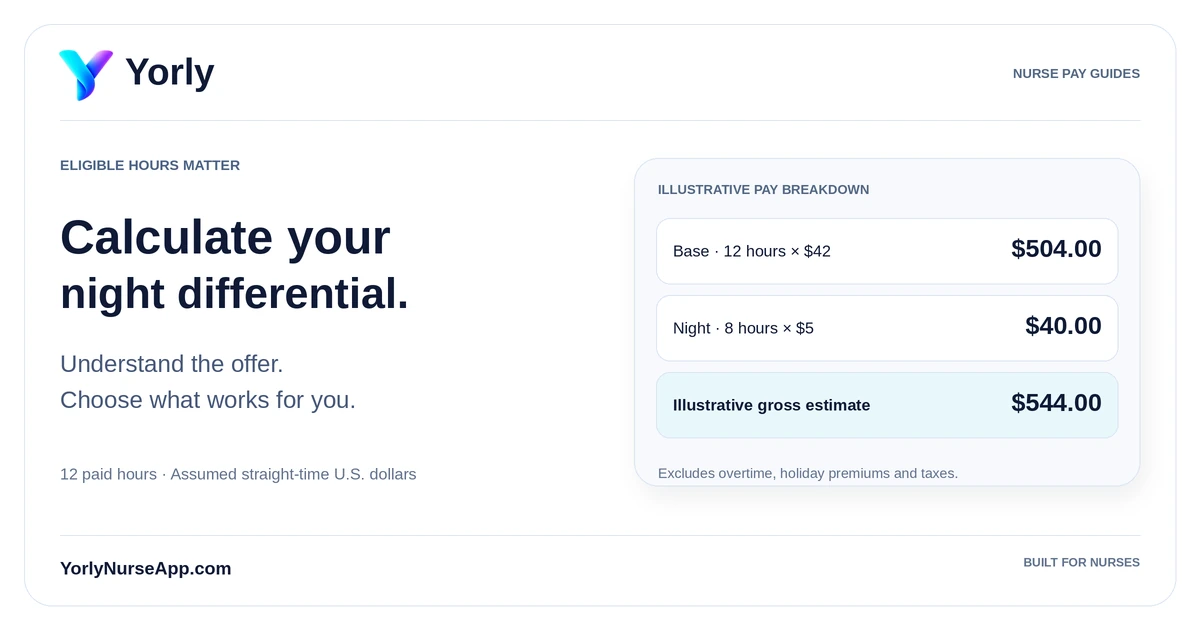
Extra night pay = hourly night differential × eligible paid night hours. Calculate base earnings separately using all paid shift hours, then add the differential. Suppose a shift has 12 paid hours at $42 per hour, but only 8 hours qualify for an additional $5 night differential.
| Pay component | Amount |
|---|---|
| Base: 12 × $42 | $504.00 |
| Night differential: 8 × $5 | $40.00 |
| Illustrative gross shift pay | $544.00 |
Applying the $5 to all 12 hours would produce $60 in differential pay and overstate this example by $20. The relevant number is eligible paid hours, not simply the scheduled shift length.
If the scheduled shift is 12 hours with a 30-minute unpaid break, base paid hours would be 11.5. Eligible differential hours also decrease if that unpaid break falls inside the qualifying window. Confirm how your actual break and timekeeping rules work.
3. Translate a percentage carefully
If the written rule is an extra 10% of a $42 base rate, the additional hourly amount is $42 × 0.10 = $4.20. For eight eligible paid hours, that adds 8 × $4.20 = $33.60. With 12 paid base hours, illustrative gross pay becomes $504 + $33.60 = $537.60.
This assumes the percentage applies only to the stated base rate. Do not use this conversion if your employer applies a percentage to another amount, has a minimum differential, or uses a different formula. Ask payroll which rate is the percentage base and how it rounds intermediate values.
4. Keep overlapping premiums separate
Suppose the same 12-paid-hour shift also qualifies for an extra $3 weekend differential for all 12 hours, and the written rules allow it to stack with the $5 night differential for eight hours. The weekend amount is $36, giving $504 + $40 + $36 = $580.
The two eligible-hour counts total 20, but that does not mean you worked 20 hours. Some hours qualify for both premiums. Each individual eligible-hour count must still fit inside the paid shift duration. If stacking is not allowed, this additive example does not apply.
5. Check overtime separately
These examples assume straight-time pay and no overtime or holiday premium. For covered, nonexempt employees, shift differentials generally enter the federal overtime regular rate. That rate can depend on compensation across the workweek, not only the shift you are pricing. Qualifying healthcare employers may use an agreed 8-and-80 system; state law or other arrangements can also change the calculation. DOL healthcare overtime guidance explains these distinctions.
Read our night differential and overtime guide for a full workweek example. Working a holiday? Our Thanksgiving pay guide explains why holiday eligibility is a separate question.
Frequently asked questions
Is a night differential the same as overtime?
No. A differential is extra compensation for qualifying shift hours under applicable rules. Overtime is a separate obligation where it applies; the differential can affect the regular rate.
Can I enter a percentage in the free calculator?
The free calculator accepts a dollar amount per eligible hour or a percentage of base hourly pay. If your employer uses a different basis or rounds differently, confirm the applicable hourly dollar amount before entering it. It does not determine the rule for you.
Is there one standard nursing night differential?
No universal amount is assumed here. Use your own written pay policy, agreement and applicable law rather than a rate from an online example.
Put your own numbers in context.
Use the free nurse shift-pay calculator for base pay, eligible dollar-based night and weekend differentials, and one flat pickup incentive. No account is needed; your pay inputs stay in your browser.
Its limits: the free calculator does not calculate overtime, holiday premiums, taxes, take-home pay, or legally required wages. It is a simplified gross estimate, not a payroll-compliance determination.
Try the free calculator ↗Sources and scope
- U.S. Department of Labor: Night Work and Shift Work
- U.S. Department of Labor: Healthcare Overtime (Fact Sheet #54)
Educational information for U.S. employment, not individualized legal, tax, payroll or financial advice. Employer policies, agreements, exemption status and applicable federal or state law may change the result. Confirm your own rules with payroll or a qualified adviser.